

Popular Voices: Computational Analysis of Poetry and Song
This edited volume brings together contributions focused on the computational analysis of popular poetic forms, both traditional and contemporary, as well as song lyrics (for instance in folk, pop, or rap), and other studies on poetic text following a quantitative or computational approach. Particular attention is given to the relationships between text and performance, and to poetic expression disseminated through new media platforms such as the social web.
Through the diversity of materials addressed, ranging from German Romantic poetry to Estonian hip-hop, and from Icelandic verse to Bukowski’s performances, the contributions share and offer an understanding of poetry as a complex phenomenon that exceeds the boundaries of print, unfolding across multiple media, traditions, and reception contexts. Collectively, the papers demonstrate how digital humanities approaches enable novel forms of analysis, showing that quantitative methods do not flatten poetic texts into abstract data nor disregard their aesthetic dimensions. Rather, processes of formalization, from basic counting procedures to advanced algorithmic modeling, provide productive means to analyze, describe, interpret, and access poetic works in ways that both complement and expand established scholarly practices.
Editors:
Mari Väina (Estonian Literary Museum)
Maria-Kristiina Lotman (University of Tartu, The Under and Tuglas Literary Institute of the Estonian Academy of Sciences)
Anne-Sophie Bories (University of Basel)
Pablo Ruiz Fabo (University of Strasbourg)
Petr Plecháč (Institute of Czech Literature of the Czech Academy of Sciences)
Susanna Mett (University of Tartu)
Language editor: Daniel Allen
Layout: Petr Plecháč
Cover design: Anne-Sophie Bories
Web design: Ilona Kolossova
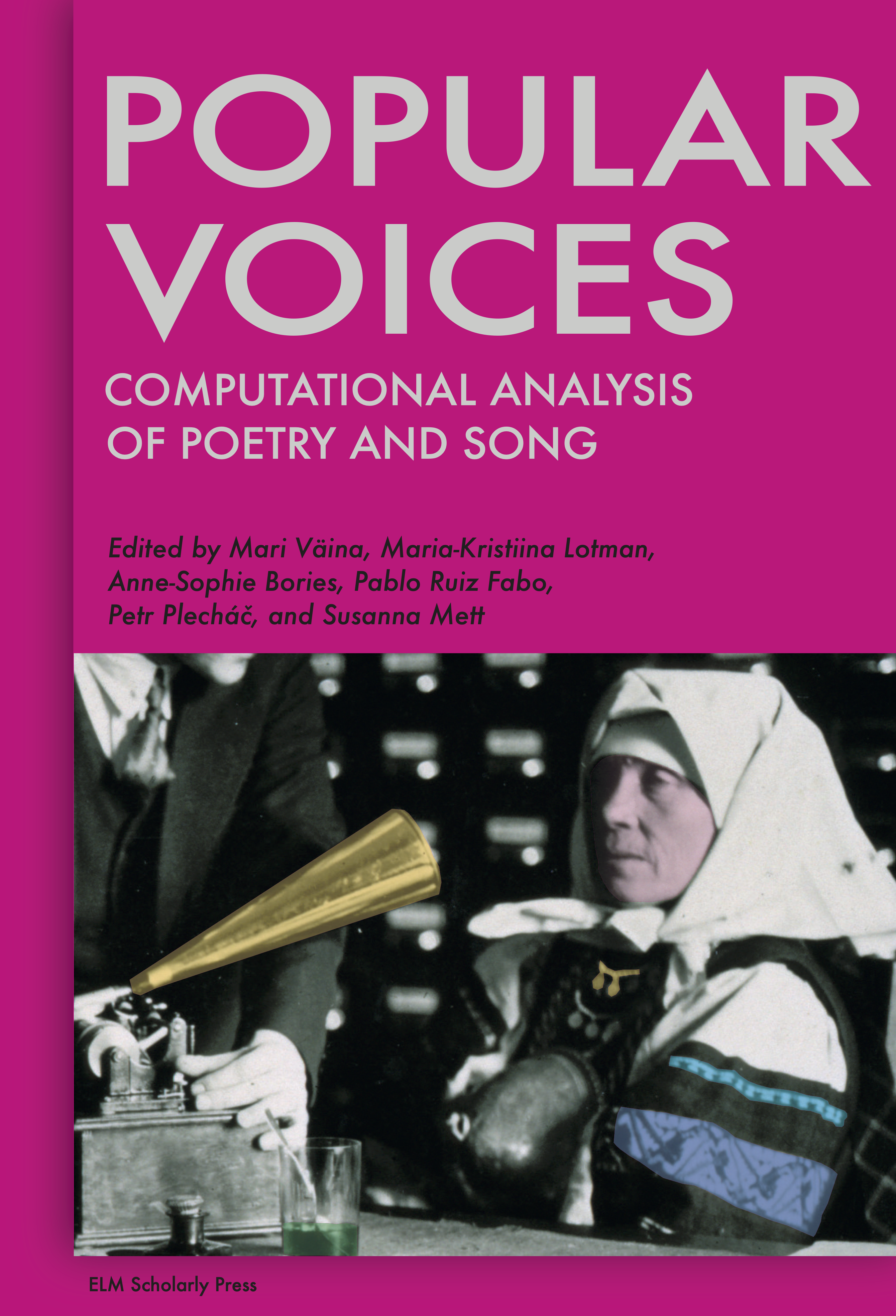
Front cover: Folk singer Akuliina Ruusamägi from Vilo parish, village Molnika. At the phonograph Oskar Loorits. ERA, DF 631 (1932).
All articles in this volume have undergone peer review, except for one invited essay based on a keynote lecture delivered at the Plotting Poetry conference held in Tartu in 2022, which is published in its original form.
The editing and publishing of this book was supported by the Estonian Research Council (PRG1288), by the Estonian Ministry of Education and Research (TK215), by the Kone Foundation, by the Swiss National Science Foundation (PRIMA Grant 185674 - Le Rire des vers), and by the European Union under the Marie Skłodowska-Curie Actions (HORIZON MSCA-2023-PF, 101149659, COMPEL - Computational Analysis of Peripheral Literatures)
© Estonian Literary Museum
© Authors
© Cover design: Anne-Sophie Bories
ELM Scholarly Press, 2025
This work is licensed under a Creative Commons Attribution–NoDerivatives 4.0 International License (CC BY-ND 4.0).
DOI: 10.7592/PP2025
ISBN 978-9916-742-77-8 (paperback)
ISBN 978-9916-742-78-5 (pdf)