

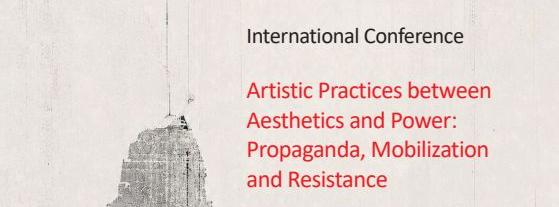
International Conference "Art Practices between Aesthetics and Power", 29 June - 1 July 2026
26.06.2026
From 29 June to 1 July, the international interdisciplinary conference Art Practices between Aesthetics and Power: Propaganda, Mobilisation and Resistance will bring together scholars and practitioners from various fields to explore the complex relationships between art, propaganda, collective memory, and social activism.
Art does not merely reflect society; it actively participates in shaping it. The conference seeks to examine how artistic practices influence public consciousness, shape understandings of history, inspire resistance, or, conversely, reinforce ideological narratives of power.
Discussions will focus on visual art, theatre, digital media, and other forms of cultural expression whose impact on political and social processes has grown significantly in recent decades. Participants will address questions concerning the role of art in political mobilisation, the representation of trauma, collective memory formation, and broader processes of social change in diverse historical and cultural contexts.
In today's world, marked by armed conflicts, identity crises, migration pressures, and increasing social tensions, art has become a powerful instrument of influence. It is used both to preserve and reshape memory, to express critical resistance and to disseminate manipulative messages. Art can amplify the voices of marginalised communities, while at the same time serving ideological purposes.
The conference invites participants to reflect on the ambivalent nature of artistic expression at the intersection of aesthetics, critique, and power. By bringing together perspectives from different disciplines, the event aims to foster a deeper understanding of how art shapes our perceptions of the past and present, and what role it may play in imagining and constructing the future.
Keynote Speakers:
Beata Waligórska-Olejniczak (Adam Mickiewicz University, Poznań, Poland)
Natalia Artemenko (TU Dortmund University, Germany)
Jan Levchenko (University of Jyväskylä, Finland; Faculty of Liberal Arts and Sciences, Budva, Montenegro)
For further details >>>